

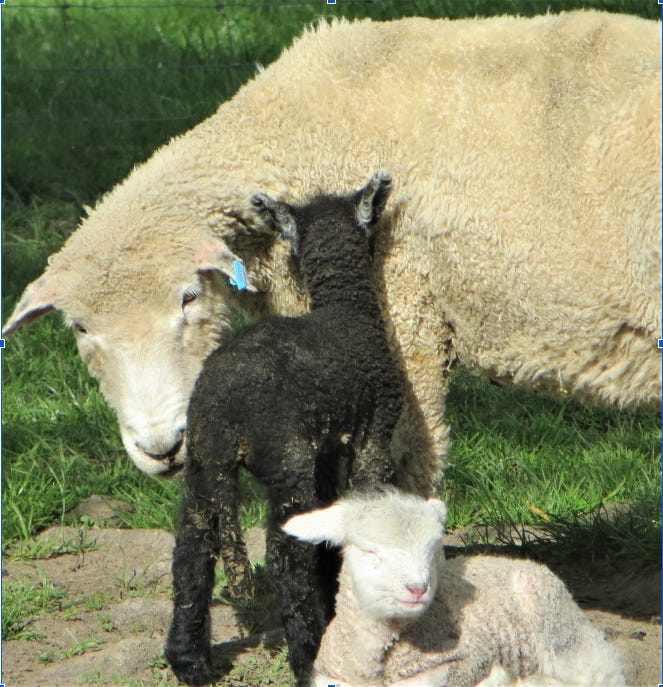
Back in the ‘90s and early 2000s, when lambing began the kids fought for the chance to drive around the sheep with Dad.
When the weather was fine it was great fun spotting the new lambs in each paddock. The kids slid merrily out of the Toyota truck to open the gates and raced to return straying twins to their mothers or sadly pick up lambs that had died overnight.
It wasn’t so much fun when the weather turned wet, windy or snowy as it often seems to in spring. Terry, of course, was there for every long lambing beat — and in those days, he went round every paddock of sheep twice a day. And when the kids couldn’t help, I got the job.
New Mums For Abandoned Lambs
Most ewes are conscientious mums. They nuzzle their babies close, and stand still as a rock when the tiny lambs search for milk. Sometimes the ewe loves one of her twins but bunts the other away. And, occasionally, a new mum will take one look at her just-born lamb and head for the hills.
In those days we picked up every stray and gave it to a ewe whose own lamb had died. This is called “mothering on” and is a lot of work. Generally, Terry spent an hour or two mothering-on at night, when it was too dark to be out in the paddocks. Night after night, he stumbled home at 9 or 10 pm, picked at his reheated dinner and then fell into bed.
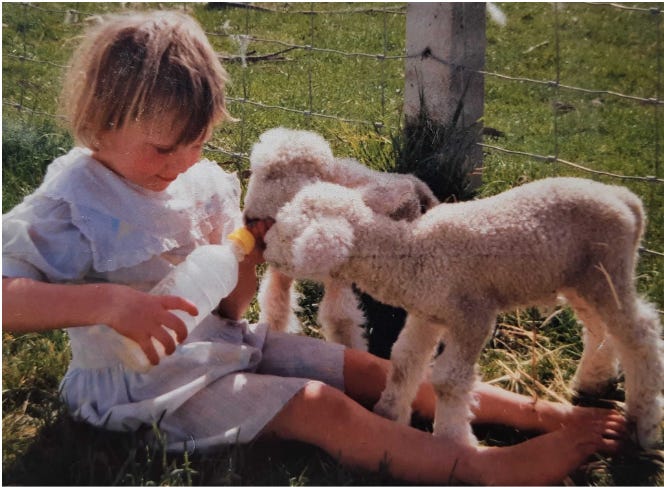
There wasn’t always a suitable mother right when we needed her so we kept the spare lambs in a sheltered pen near the house. These lambs had to be fed little and often, so while Terry was nodding over his dinner plate the kids and I would be out giving the lambs their night time bottles.
Like all newborns, lambs have a strong sucking reflex. But most lambs don’t cotton on to bottle feeding straight away. By the time they started school, all four of our kids knew how to persuade a reluctant lamb to drink.
It was just as well. By late September the lambs were coming thick and fast. There could be 20 little orphans scrambling for the bottles each night. I was so glad to have all hands on deck.
A Lamb To Remember
Every year the children begged for pets to keep. We don’t remember all the healthy ones now, but one lamb we’ll never forget.
Floppy wasn’t a pretty lamb.
His spindly back legs didn’t work the way they should have, so he was always last to the milk at feeding time. All the other pet lambs raced to the bottles and gobbled. Huge, milky bubbles frothed around their mouths and they choked in the rush to be finished. When the last drop of milk was gone they scampered away.
But Floppy loved a cuddle and Debbie gave him hundreds of them. Every day after feeding time they curled up together and I found the two friends in some funny places. Sometimes they lay in a sunny spot in the grass. On cold days they wobbled over to the hay barn and played in the hay. And, when it was hot, they curled under the trees and slept.
Floppy’s spirit was strong, but his body grew weaker as the weeks went by. His wobbly legs gave out but still, he didn’t give up. He sat in the sun by the gate and baaed for his bottle and a cuddle whenever we walked out the door.
We held a funeral when at last he gave up the fight.
Opening The Gates —
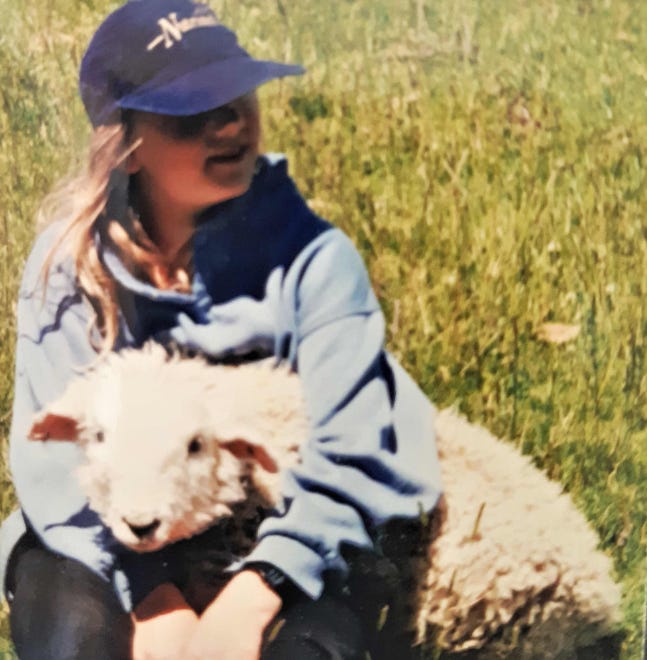
In those days we shut small mobs of sheep into each paddock. This is called set-stocking. We had so many paddocks, that having a dedicated gate opener saved Terry time and energy.
It wasn’t always the kids who helped. My parents loved to escape their city routine and come lambing in the weekends. So did our cousins and their friends. Those kids are adults now, but every one of them remembers those exciting holidays on the farm.
I bet you think that gate opening is a piece of cake. All you have to do is:
Leap out of the truck
Unhook the chain
Push open the gate
Wait for the truck to drive through
Push the gate shut
Hook up the chain
Haul yourself back into the truck
Repeat in every paddock.
It sounds simple, but it wasn’t.
Every gate had a different kind of latch or chain. Some were easy to unlatch but tricky to hook up again. Others, exactly the opposite.
Many gates swung easily high on their hinges. But some had sagged and dragged on the ground. We had to lift and heave those gates bit by bit while the truck revved impatiently on the other side.
Most of our gates were sturdy metal ones. But a few were ancient wooden affairs. We held our breath, hoping they’d stay in one piece when we tugged them open.
— And Other Lambing Jobs
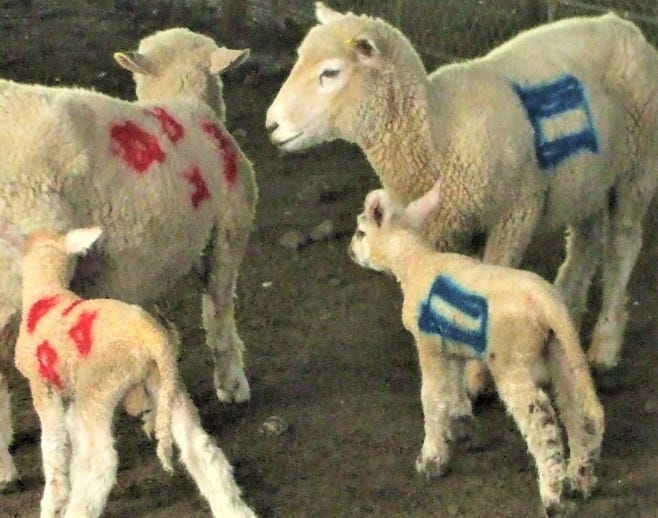
We used to mark each set of twins with a colourful spray and that made it easy to spot a twin who’d wandered away. We’d pick it up and find the mother by looking for a lamb with the same mark.
Before Terry and I were married, the men simply put dots or lines on the lamb’s head, ears, neck or back. A circle always meant triplets. The kids and I were more creative. We sprayed stars, crescent moons, numbers, letters… Terry didn’t care what we did — so long as he could easily spot the mark.
Spraying twins was another of the ‘easy’ jobs. All you had to do was:
jump out of the truck,
scoop up the twins,
spray exactly the same mark on each lamb
and dash back without disturbing the ewe and lambs.
Simple! Or was it?
Sometimes, one or both lambs thought you were their new best friend and followed you, bleating at the top of their lungs. So, you turned them around and patted them towards their mum. But no, back they came.
You pushed them with the shepherd’s crook. Back they came again. You tangled them up, one on top of the other. Still, those persistent little creatures dashed under your feet.
In the end, there was only one thing to do: hop into the truck and drive in a circle around the ewe with lambs dashing behind. Usually, they met in the middle and the lambs would dive for their milk, tails wagging full bore.
But We Work Differently Now
Nowadays we don’t mark the twins any more. We’re trying to keep things natural and disturb the sheep as little as possible. And, you know what? It turns out that 99% of those wandering lambs find their mums without any help from us. We save a lot of time and effort when we don’t know what belongs where.
We do spray the ewes and lambs who’ve been mothered on. We put the same mark on both the ewe and her adopted lamb, just in case they get separated.
Back They Come
Our kids grew up long ago, but every year someone comes home to help out at lambing time. For a while, each of the girls seemed to take it in turns. Nowadays, Chris is in charge but Jenny and her kids come down for a week each spring to get a dose of farming life.
We love it when they come back and truly appreciate their help.
Life on the farm circles through the seasons and lambing is the start of it all.
The way we lamb may have changed, but the joy of new life stays the same. We’ve seen thousands of new lambs over the years, and we still get a kick out of watching them play in the paddocks, nuzzle their mums or sleep in the sun.
Terry’s got a wealth of knowledge and instinct when it comes to caring for his stock. I love the way he has passed it on to our kids and grandkids — and so do they.